Does a nagging discomfort in your buttocks make it difficult to sit still or walk comfortably? Buttock pain is a common complaint with many possible causes, ranging from muscle strains and joint dysfunction to nerve-related conditions. Physiotherapist Timothy Lau from Milestone Physiotherapy shares his expertise on the common causes of buttock pain and how physiotherapy can help.
When thinking about the hip, many people focus only on the gluteal muscles—and these are often involved. However, the anatomy of the posterior hip is far more complex, comprising bones, joints, ligaments, nerves and several muscle groups. Identifying the underlying cause is therefore essential for effective treatment.
Below, we explore some of the common conditions that can cause buttock pain. These can be broadly grouped into three categories: musculoskeletal, neurological and other causes.
Musculoskeletal Causes of Buttock Pain
Musculoskeletal causes involve the muscles, tendons, bones or joints around the hip and pelvis.
Gluteal Muscle Strain
A gluteal muscle strain is one of the most common causes of buttock pain. Of the three gluteal muscles, the gluteus medius and gluteus minimus are most commonly affected.
A strain occurs when the muscle fibres are overstretched or torn. This may result from a sudden, forceful contraction, direct trauma, overuse or overexertion during physical activity. It can cause sharp or aching pain, as well as tenderness around the affected area. Gluteal muscle strains are particularly common in sports involving sprinting, jumping or sudden changes in direction.
Gluteal muscle strains frequently occur during sports that require sprinting, jumping or rapid changes in direction.
Symptoms may include:
- Localised pain in the back or side of the hip
- Swelling, bruising and/or tenderness
- Pain that worsens when using the affected muscles, such as when walking, climbing stairs or running
- Pain when pressure is applied to the area, such as when lying on the affected side or sitting for prolonged periods
Gluteal Tendinopathy
Gluteal tendinopathy affects the tendons that connect the gluteal muscles to the hip bone at the greater trochanter. It often involves degeneration and/or inflammation of these tendons, leading to pain and weakness around the outer hip.
The condition commonly develops due to repetitive strain on the tendons, insufficient recovery or the gradual accumulation of microtrauma. It is most frequently seen in people over the age of 40, particularly women, and is often associated with repetitive activities such as running, walking long distances or standing for prolonged periods.
Repetitive activities such as running, walking long distances or standing for prolonged periods can lead to gluteal tendinopathy.
The symptoms of gluteal tendinopathy can closely resemble those of a gluteal muscle strain.
Proximal Hamstring Strain and/or Tendinopathy
This condition involves injury to or degeneration of the hamstring tendons where they attach to the ischial tuberosity, commonly known as the “sitting bone”. It is frequently seen in runners and athletes, and its causes are similar to those of gluteal muscle strains and tendinopathy. Symptoms may include:
- Deep pain at the base of the buttock, around the “sitting bone”
- Discomfort when sitting, particularly on hard surfaces
- Pain and, in some cases, weakness when sprinting, lunging or bending forward
Piriformis Syndrome (also known as Deep Gluteal Syndrome)
Piriformis syndrome occurs when the piriformis muscle, located deep within the buttocks, compresses the sciatic nerve. This may happen when the muscle becomes tight, enlarged or inflamed. The condition is also commonly associated with weakness or poor activation of the gluteus maximus and/or gluteus medius muscles.
Weakness in these gluteal muscles can affect hip mechanics during movement, particularly during weight-bearing activities such as walking, climbing stairs or squatting. This may cause the hip to move excessively inwards through adduction and internal rotation, placing greater demand on the piriformis muscle. Over time, the increased load can strain the piriformis and raise the risk of developing piriformis syndrome.
Symptoms may include:
- Deep pain within the buttock
- Pain or numbness that radiates down the back of the leg, similar to sciatica
- Pain that worsens with prolonged sitting, hip rotation or direct pressure on the muscle
- Discomfort aggravated by prolonged standing, walking, climbing stairs or squatting
.png?width=400&height=400&name=blog_Getting%20to%20the%20Bottom%20of%20Buttock%20Pain%20and%20How%20Physiotherapy%20Can%20Help%20(2).png)
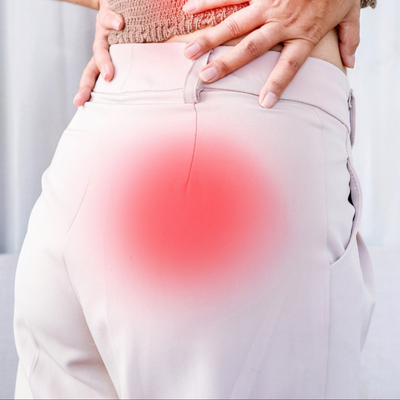
Prolonged sitting can aggravate buttock pain, whether the underlying cause is musculoskeletal, neurological or otherwise.
Neurological Causes of Buttock Pain
Neurological causes typically involve irritation or compression of nerves that can refer pain to the buttocks.
Lumbar Radiculopathy (commonly affecting L4–S1)
A herniated disc, spinal stenosis or degenerative changes in the lumbar spine can irritate the nerve roots, resulting in pain that radiates into the buttocks and legs.
Symptoms may include:
- Sharp, burning or shooting pain extending from the lower back into the buttock
- Numbness, tingling or weakness in the leg
- Pain that worsens with prolonged sitting, bending or lifting
Sciatic Nerve Entrapment
While piriformis syndrome is one possible cause, the sciatic nerve can also be irritated or compressed by other structures, including surrounding soft tissue or scar tissue following surgery.
Other Causes of Buttock Pain
Greater Trochanteric Pain Syndrome and Ischial Bursitis
Bursae are small, fluid-filled sacs found throughout the body. They act as cushions, helping to reduce friction between moving tissues. Two key bursae around the back and side of the hip are the ischiogluteal bursa and the trochanteric bursa. Irritation or inflammation of these bursae can contribute to pain around the hip and buttock.
This may result from repetitive movements, overuse or prolonged pressure on the affected area. Direct trauma, such as a fall, can also trigger irritation. In some cases, poor movement mechanics or muscle imbalances may place additional stress on the surrounding tissues, increasing the likelihood of symptoms. Underlying conditions such as rheumatoid arthritis or gout, as well as infections, may also cause bursae to become inflamed.
Identifying the underlying cause—whether biomechanical, inflammatory or activity-related—is therefore important for effective management.
Symptoms may include:
- Pain around the outside of the hip or buttock
- Pain that worsens when lying on the affected side
- Tenderness over the outside of the hip, around the greater trochanter
Sacroiliac Joint (SIJ) Dysfunction
The sacroiliac joints connect the spine to the pelvis. Pain may occur when these joints become irritated or inflamed, or when they do not move as expected.
Symptoms may include:
- Pain near the dimples of the lower back, sometimes radiating into the buttock or thigh
- Pain that worsens when standing up from a seated position, walking uphill or turning over in bed
Getting to the Bottom of Buttock Pain
Buttock pain can affect anyone, though it is more common among middle-aged and older adults, people with sedentary lifestyles, individuals who regularly engage in repetitive athletic activities, and those with existing back, hip, or nerve-related conditions. Some causes, such as gluteal tendinopathy and piriformis syndrome, may also be more common among women.
The posterior hip is a complex area, and pain can arise from many different structures. Identifying the source of the pain is therefore essential for effective treatment. If the underlying cause is incorrectly identified, treatment may be ineffective or could potentially aggravate the condition.
A physiotherapist can assess your movement, strength and posture to help determine the root cause of your symptoms. Based on this assessment, they can develop a personalised treatment plan to reduce pain, restore movement and lower the risk of the problem recurring.
If your buttock pain persists or worsens, consider consulting a physiotherapist for an appropriate assessment and guidance.
Featured Contributor:

Milestone Physiotherapy
Milestone Physiotherapy commits to helping clients achieve their wellness and fitness goals one step at a time. They specialise in return to sports post-surgery and post-injury, sports performance, strength and conditioning, and management of acute and chronic musculoskeletal conditions.
Connect with Milestone on their website, Facebook, and Instagram.
.png?width=400&height=400&name=blog_Getting%20to%20the%20Bottom%20of%20Buttock%20Pain%20and%20How%20Physiotherapy%20Can%20Help%20(3).png)