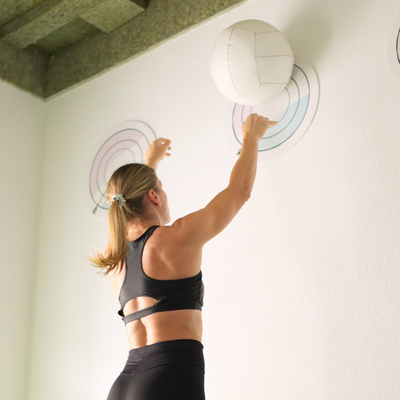
HYROX is fast becoming one of the most talked-about fitness races in Singapore and around the world. Its appeal is clear — it is challenging yet accessible, with different entry categories and race formats that allow people of varying fitness levels to take part. But as more athletes prepare for the demands of the race, I have also noticed a recurring issue among clients in clinic: shoulder pain during the Wall Ball Station.
Among the athletes and clients I see in clinic preparing for HYROX, one of the most common complaints is shoulder pain during the Wall Ball Station. When performed with proper form, wall balls should not trigger shoulder pain. So when discomfort does show up, it is often a sign that something deeper needs to be addressed.
Why Wall Balls Can Be So Demanding
The Wall Ball Station places significant demands on the body because it involves:
- coordinated effort between both the upper and lower body
- repetitive overhead movement
- muscular fatigue as the race progresses
- underlying muscle imbalances
- poor movement mechanics
- compensatory patterns that place added stress on the shoulder
When these factors combine, the shoulder can become overloaded, especially in athletes who are already training at high volume or intensity.
Shoulder pain during wall balls is often not caused by just one issue. More commonly, it is the result of a combination of mobility restrictions, muscle weakness, fatigue, and inefficient biomechanics. In clinic, this can present as pain at the end range of overhead movement, tightness through the neck and shoulders, or reduced control of the scapular muscles.
A Closer Look at One Client’s Experience
Recently, I saw a client who was in the middle of preparing for HYROX and had started noticing pain in the right shoulder during wall balls. Although the pain had only been present for about a week, it was already beginning to affect training and was most noticeable during the Wall Ball Station.
Alongside the pain, the client also felt some restriction and mild discomfort when reaching overhead, especially at the end range of the movement. On assessment, a few things stood out: there was mild tightness and pain at the top of shoulder elevation, some limitation in thoracic spine extension, tightness through the neck muscles, and weakness in the scapular muscles. Taken together, these findings suggested that the shoulder was not working as efficiently as it could under the demands of repeated overhead movement.
The focus of treatment was not just on reducing pain, but on helping the client understand what was driving it. We worked on education around the diagnosis, pain management, and small but important modifications to both daily activity and HYROX preparation. From there, the goal was to support a gradual and confident return to wall balls, while improving the movement mechanics that may have contributed to the issue in the first place.
Treatment Approach
Treatment will vary depending on the individual and the underlying cause of pain, but in this case, the focus was on reducing pain, improving mobility, restoring muscle function, and supporting a safe return to training. This included a combination of soft tissue release for tight muscles, cryotherapy, manual therapy, and joint mobilisation where appropriate.
Part of the treatment focused on improving movement quality through muscle activation, movement retraining, and a mix of passive and active stretching.
We also worked on central nervous system retraining, muscle activation, and a mix of passive and active stretching to improve movement quality. From there, rehabilitation progressed into more targeted exercises, including specific strengthening work and Wall Ball Station movement pattern retraining, to help the client return to overhead loading with better control and confidence.
Practical Tips for HYROX Athletes
Pain should not be ignored, especially when it starts to affect training or everyday movement. While not every ache automatically means serious injury, persistent or worsening pain is a sign that something needs attention.
It is worth seeking medical advice if HYROX training or daily activities aggravate the pain, if the pain remains consistent or keeps returning for more than a few days, or if you begin to feel pain at rest or during sleep. These can all be signs that the issue is progressing beyond normal post-training soreness.
Most importantly, do not push through pain. What begins as a mild acute issue can become a longer-term chronic problem if left unaddressed, and chronic pain often takes much longer to treat and recover from. If pain is stopping you from returning to sport, leisure activities, or even daily tasks comfortably, it is a clear sign that proper assessment and treatment are needed.
Featured Contributor:

Kalidass Murugan, Physiodass Spine & Sports Rehab
With an M. Adv. in Clinical Physiotherapy (Musculoskeletal) from Australia, Kalidass, known as Dass, has more than 10 years of experience working at public hospital and private clinic settings treating Musculoskeletal conditions, Sports injuries and Post-operative management. He has served with Team Singapore as a physiotherapist in the medical team in SEA Games and ASEAN Para Games in 2015.
Connect with Kalidass on Facebook and Instagram.


.png?width=400&height=400&name=blog_The%20Most%20Common%20HYROX%20Injuries%20I%20See%20as%20a%20Physiotherapist%20(2).png)
.png?width=400&height=400&name=blog_The%20Most%20Common%20HYROX%20Injuries%20I%20See%20as%20a%20Physiotherapist%20(4).png)
-Mar-11-2026-07-57-24-2195-AM.gif?width=400&height=400&name=Blog%20Content%20(square%20dimensions)-Mar-11-2026-07-57-24-2195-AM.gif)
.png?width=400&height=400&name=blog_The%20Most%20Common%20HYROX%20Injuries%20I%20See%20as%20a%20Physiotherapist%20(3).png)